Beyond Flaky Tests: How Modern QA Solves The Reliability Problem
The software teams of any industry are constantly working to provide quality releases with minimal or zero failures. Nevertheless, despite sophisticated test suites, automation pipelines, and a well-established DevOps culture, there is still one constant impediment: flaky tests. They are inconsistent tests that may not pass without actual modification of code, which wastes engineering teams' time, trust, and confidence. This is not only a technical issue but also a cultural one since flaky tests have an impact on morale, cadence of delivery, and decision-making. They also decelerate, hinder CI/CD pipelines, decrease the rate of deployment, and heighten the cost of operation. Digital systems are becoming more modular, cloud-based, and distributed, necessitating the need for more strategic, scalable, and intelligent testing methods.
Flaky test problems have no connection to a particular tool or framework; they are the consequences of more fundamental architectural, environmental, and procedural loopholes. The shift to monoliths to microservices, API-based integrations, containerized applications, and serverless functions has made testing much more complex. The current testing team needs not only automation but also stability-first engineering, which places reliability metrics, constant feedback, and validation on real users first.
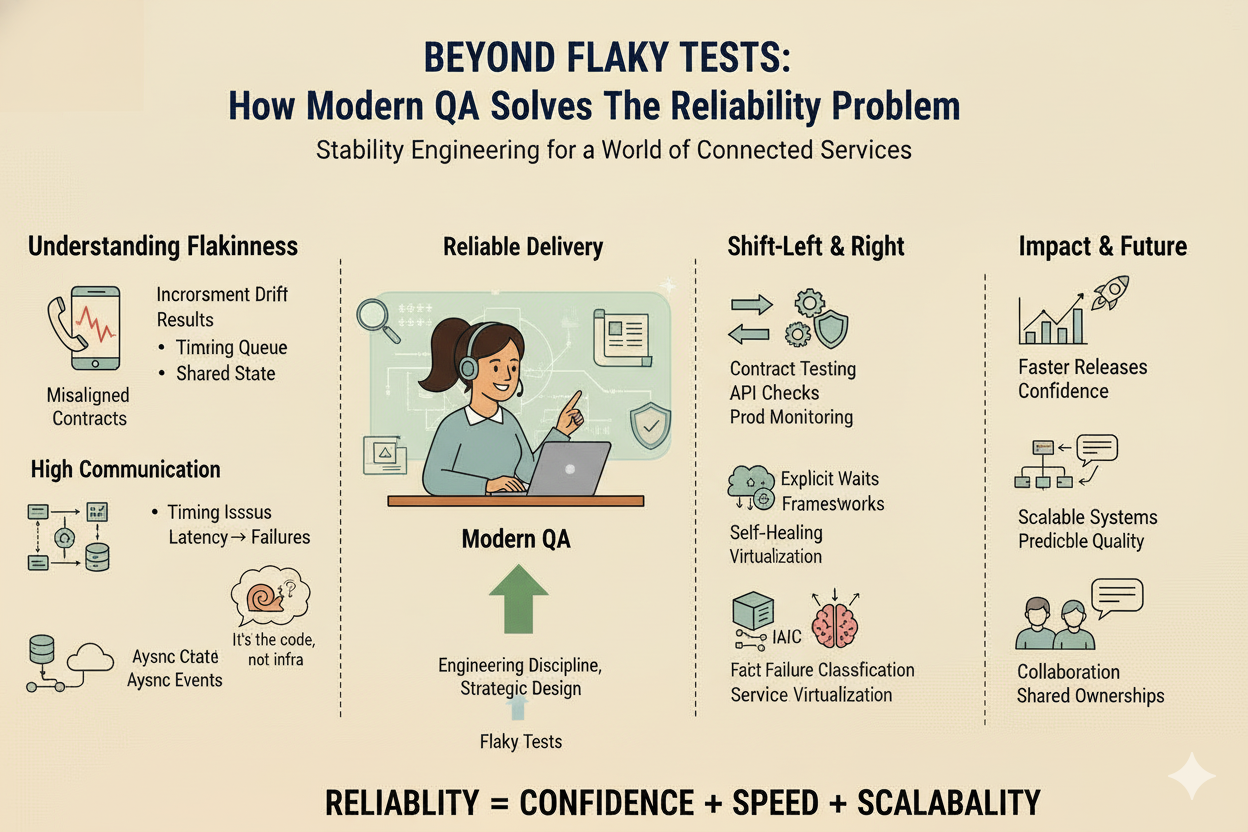
What Creates Flaky Tests Today
Many reasons are given behind the occurrence of flaky tests, including test environment instability and poor test data design. Unpredictable results are often produced by network delays as well as asynchronous events, background jobs, and third-party dependencies. Some of the sources of inconsistency are non-deterministic test steps, conflicts of shared resources, poor synchronization, and environment drift. Random results are also brought about by external factors such as variable latency, virtualized infrastructure, and container-based execution.
Testers also fail to understand root causes and expect flaky behavior to be nothing other than a script problem. In practice, flaky tests are often due to slow architecture or external service, or random cloud infrastructure behavior. The other significant factor is the test design, which has been largely dependent on the UI layer, so that it is possible to test the scenario much more effectively and reliably by relying on lower-level checks.
How Modern QA Teams Are Solving Test Reliability
Progressive QA departments have ceased to see automation as a procedure and have recognized it as a business engineering field. Observability principles, resilient test pattern libraries, and environment standardization now achieve stability. Service virtualization, synthetic data generation, and deterministic execution strategies decrease the number of external dependencies and increase the success rate.
Shift-right testing adds real user monitoring and feedback loops in production to enable automation engineers to focus on critical fixes based on business impact. The use of AI to classify failures is also gaining a lot of popularity to determine patterns, isolate the likely causes, and weed out false alarms.
Full reliability is being made possible by blending functional testing, performance testing, security testing, and contract testing, supported by logging and metrics, as well as traceability tools. Parallelization platforms, quality gates in CI pipelines, and root-cause dashboards also help reduce uncertainty. At the same time, organizations increasingly rely on specialized API automation testing services and microservices testing services to address complex integration points.
Tools and Techniques Reshaping Test Stability
Automation frameworks alone cannot guarantee dependable results. A stability-first QA model involves several modern approaches:
- Contract Testing and Consumer-Driven Tests: Validates interactions between services rather than full-system dependencies.
- Network and Latency Simulation: Helps predict behavior under real-world conditions without breaking pipelines.
- Smart Retry and Adaptive Wait Mechanisms: Ensures asynchronous operations complete without over-synchronization.
- Test Data Containers and Disposable Test Beds: Minimizes shared-state conflict and eliminates data contamination.
- Chaos Engineering for QA: Introduces resilience thinking beyond functional assurance.
- Infrastructure-as-Code Test Environments: Ensures reproducible environments across local and CI systems.
Besides contemporary tooling, the teams invest in highly qualified QA talent capable of comprehending architecture, performance, security, and automation engineering to help in delivering end-to-end reliability. Companies that do not use it as a support tool but as an element of product strategy are winning at a faster rate.
Why Expert Partners Matter in Reliability Engineering
Many businesses still operate with automation scripts that work locally but fail under enterprise scale. Test frameworks may be advanced, but without reliability architecture and expert oversight, flakiness persists. Mature engineering teams adopt combined quality competencies, including observability, SRE alignment, and continuous validation.
Organizations often collaborate with advanced software testing partners to reduce flaky test density and enhance stability metrics. Modern digital companies leverage specialized expert teams such as Selenium automation testing services, Selenium testing services, and dedicated engineering talent for long-term automation stability. Businesses also choose to hire Selenium developers or even hire remote Selenium developers when scaling globally or when in-house expertise is insufficient. Many technology organizations additionally choose to hire QA engineers and hire test automation experts when scaling high-traffic platforms, enterprise SaaS systems, or API-centric architectures.
Conclusion
Flaky tests are not simply a nuisance but a critical barrier to software quality maturity. They waste time, erode trust, and slow deployment velocity. Current QA practices have integrated automation engineering, distributed architecture alignment, production-based metrics, and smart observability practices. With knowledge of root causes, the embracement of resilient testing strategies, and the introduction of skilled talent into the quality engineering ecosystem, organizations shift from the concept of fragile automation to the concept of stable, scalable, and predictable delivery cycles.
Futuristic, reliable testing has been in the integration of robust design, advanced tooling, and a QA strategy that is driven by experts. Once with the right mindset, testing ceases to be reactive in problem-solving and becomes instead, proactive in quality intelligence so that teams can produce innovation at a faster speed with confidence and clarity.
